Why I Admire Kano Model
When I first came across the Kano Model, I treated it like most other product management frameworks. I assumed it was simply another tool for prioritising features and understanding customer satisfaction. The more I studied it, however, the more I realised that it explains something far deeper. It is not merely a framework for products. It is a framework for understanding how expectations evolve over time.
What fascinates me about the Kano Model is that it captures a pattern that exists everywhere. We see it in technology, consumer behaviour, personal finance, careers, and even relationships. The framework explains a simple but powerful truth: what delights us today eventually becomes something we expect tomorrow. Once I started viewing the model through that lens, it stopped feeling like a product management concept and started feeling like a model of human psychology.
"Delight is temporary. Expectations are permanent."
Understanding The Kano Model
The Kano Model was developed by Professor Noriaki Kano in the 1980s to explain how different product features influence customer satisfaction. Unlike traditional thinking, which assumes that adding more features automatically increases happiness, the Kano Model suggests that different features contribute to satisfaction in fundamentally different ways.
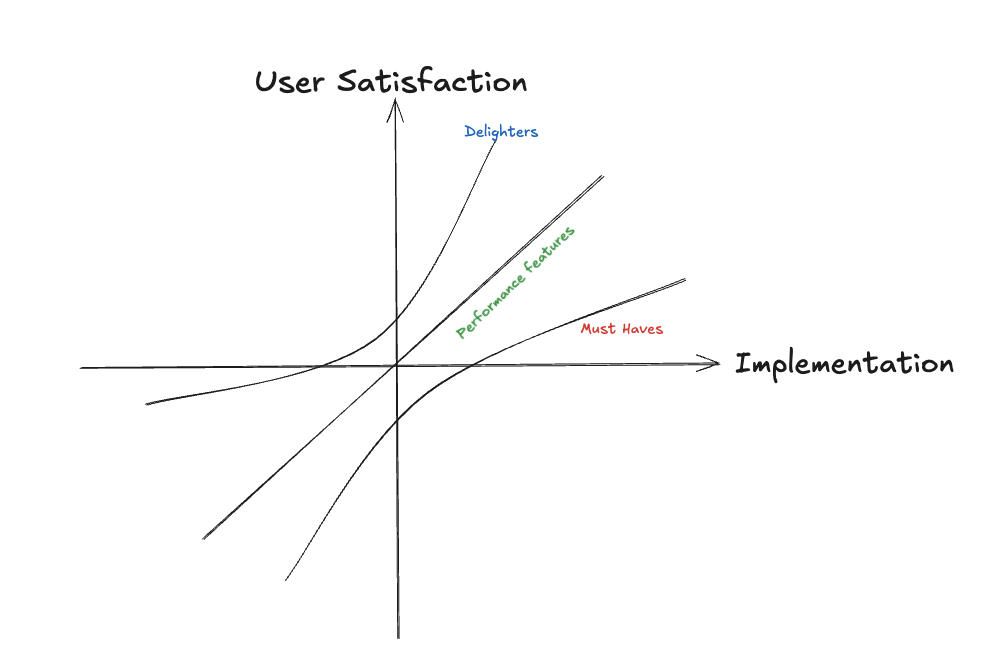
The framework categorises features into three primary groups that most product managers encounter regularly. The first category is Must-Have Needs. These are basic expectations that users assume will exist. Customers rarely praise them when present, but they immediately notice when they are absent. For example, nobody compliments a payment app because transactions work correctly, but everyone complains the moment a transaction fails.
The second category is Performance Needs. These are features where satisfaction increases proportionally with performance. Faster delivery, better battery life, stronger cameras, and lower prices all fall into this category. The better the performance, the happier the customer becomes.
The third category, and perhaps the most interesting one, is Delighters. These are unexpected features that users never explicitly asked for. Their absence does not create dissatisfaction because customers never expected them in the first place. Yet when they appear, they create disproportionately high satisfaction because they exceed expectations.
"Users rarely remember what they expected. They remember what surprised them."
Why The Kano Model Feels Like A Clock
Most explanations of the Kano Model focus on classifying features. What interests me more is the movement between categories. If I had to visualise the framework, I would not draw the traditional Kano graph. Instead, I would draw a clock.
A clock only moves forward.
It never moves backwards.
The same thing happens with customer expectations.
A feature that begins its life as a Delighter does not remain a Delighter forever. Over time, users become familiar with it. They start relying on it. What once felt magical gradually becomes normal. Eventually, it becomes something they expect every product to provide.
The journey often looks like this:
- Delighter
- Performance Need
- Must-Have Need
Think about features such as ride tracking, online payments, free shipping, cloud storage, or personalised recommendations. Each of these innovations created delight when they first appeared. Today, many users consider them basic requirements.
The feature itself did not change.
The expectation did.
That is why I often think of the Kano Model as a clock. Expectations keep moving forward regardless of whether products keep up.
Human Needs Follow The Same Pattern
The more I thought about the Kano Model, the more I realised that human desires behave in exactly the same way.
Consider a simple example. A student desperately wants their first job. Landing that job feels like a life-changing achievement. Yet within a few months, the excitement fades and a new goal emerges. The focus shifts towards a promotion, a better salary, a larger company, or a more prestigious title.
The original goal that once felt extraordinary gradually becomes the baseline.
This process repeats throughout life. We achieve something we once considered a dream, enjoy the satisfaction briefly, and then move on to the next aspiration. Our expectations continuously reset themselves to a higher level.
The Kano Model captures this perfectly. Yesterday's delight becomes today's expectation. Today's expectation becomes tomorrow's minimum standard.
"The moment we achieve a goal, our mind quietly creates another one."
The Psychology Of Money Connection
This idea immediately reminded me of The Psychology of Money by Morgan Housel. One of the recurring themes in the book is that wealth is often relative rather than absolute. People rarely compare themselves to who they were five years ago. Instead, they compare themselves to the people around them.
As income grows, expectations tend to grow alongside it. A larger salary leads to a larger lifestyle. A bigger house becomes normal. A more expensive car becomes expected. The things that once felt luxurious slowly become ordinary.
Viewed through the lens of the Kano Model, many financial decisions follow the same pattern.
A lifestyle upgrade initially behaves like a Delighter. It creates excitement and satisfaction because it exceeds expectations. After some time, it transitions into a Performance Need because people begin evaluating whether they have enough of it. Eventually, it becomes a Must-Have because they cannot imagine living without it.
This explains why increasing wealth does not always create increasing happiness. Expectations evolve alongside circumstances.
The clock keeps moving.
Why Product Managers Should Care
One of the most dangerous assumptions a product team can make is believing that today's differentiator will remain a differentiator forever. History repeatedly shows that this is not true.
Many of the features that once helped companies stand out eventually became industry standards. What was once a competitive advantage slowly transformed into a customer expectation. Companies that fail to recognise this shift often find themselves wondering why users no longer appreciate the features that once generated excitement.
The challenge for product managers is not simply building great features. The challenge is understanding where those features sit on the Kano curve today and where they are likely to sit tomorrow.
That requires continuous discovery, continuous experimentation, and continuous innovation. The moment a company stops moving, customer expectations continue moving without them.
"Products stand still. Expectations don't."
My Biggest Takeaway
The reason I admire the Kano Model is not because it helps prioritise features. There are dozens of frameworks that can do that. What makes Kano special is that it explains a fundamental truth about both products and people.
We are creatures of adaptation:
- We adapt to technology.
- We adapt to comfort.
- We adapt to wealth.
- We adapt to success.
The things that once amazed us eventually become ordinary. The things that once felt extraordinary eventually become expected. This cycle appears repeatedly across products, careers, relationships, and personal goals.
That is why I no longer view the Kano Model as a product management framework alone. To me, it is a framework for understanding how expectations evolve and why satisfaction is often temporary.
The model reminds us that progress is not just about building better products. It is also about recognising that human expectations are always moving forward. Like the hands of a clock, they never stop.
And perhaps that is exactly what makes the Kano Model so timeless.